About Soxhlet apparatus
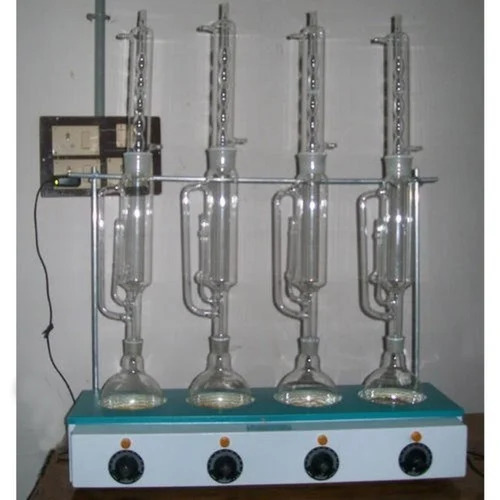
The Soxhlet Apparatus is simple to set up and use, and it features ground glass joints for easy dismantling and cleaning.
Features:
Consistent serviceability
Accurate design
High functioning
Efficient Lipid & Compound ExtractionDesigned to extract fats and soluble chemicals from solid materials, the Soxhlet apparatus automates the solvent reflux and siphoning cycles, maximizing extraction efficiency. The detachable Allihn or Liebig condenser ensures optimal condensation, minimizing solvent loss and providing reliable, repeatable results. This system is suitable for research, academic, and industrial laboratories requiring accurate compositional analysis.
High-Quality, Durable ConstructionManufactured from high-grade Borosilicate glass 3.3, this Soxhlet apparatus offers exceptional resistance to thermal shock, corrosion, and chemical attack. Its transparent, easy-to-clean glass makes observation simple throughout extraction. Joint clips and required gaskets are included for secure, leak-proof assembly, while its compatibility with most lab heating mantles or hotplates guarantees broad usability.
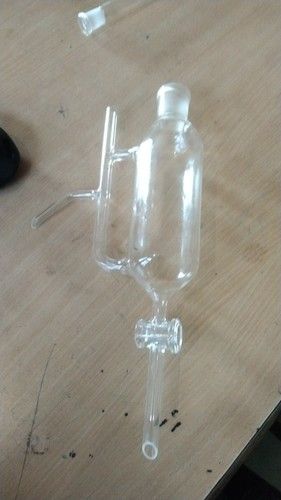
User-Friendly and Versatile DesignFeaturing standard ground joints, an integrated siphon tube, and compatibility with a wide range of thimble sizes, this extractor supports diverse laboratory workflows. Easy manual operation allows users to customize extraction protocols based on sample and solvent requirements. The apparatus is not compatible with microwave heating but integrates seamlessly with traditional lab equipment for consistent performance.
FAQs of Soxhlet apparatus:
Q: How does the Soxhlet apparatus with Allihn or Liebig condenser function during extraction?
A: The Soxhlet apparatus operates by repeatedly dissolving soluble compounds from a solid sample using a solvent. The heated solvent vapor condenses in the detachable Allihn or Liebig condenser and drips onto the sample. Once the chamber fills to the siphon tube level, the solution returns to the boiling flask, ensuring efficient extraction cycles.
Q: What materials are used in this Soxhlet extractor and why?
A: This apparatus is made primarily from high-grade Borosilicate glass 3.3 for its durability, transparency, and high thermal resistance (up to 350C), making it suitable for most laboratory solvents and heating conditions. Select cork, metal parts, and accessories are included to ensure a robust and leak-proof setup.
Q: When should a Soxhlet apparatus be used instead of simple solvent extraction?
A: Soxhlet extraction is preferred when a compounds solubility in the chosen solvent is limited, or when exhaustive extraction is required. It is notably effective for extracting fats, oils, or other soluble components from solid matrices, ensuring more complete and automated extraction than batch solvent techniques.
Q: Where can the Soxhlet extractor be set up in the laboratory?
A: The apparatus fits securely on standard laboratory stands and clamps, and should be assembled on a stable lab bench with appropriate ventilation. It can be paired with any compatible heating mantle or hotplate for the desired solvent boiling point; microwave ovens should not be used.
Q: What is the extraction process using this apparatus?
A: The process involves placing a solid sample in a compatible thimble within the extractor, adding solvent to the boiling flask, assembling the apparatus, and gently heating. Solvent vapors rise, condense in the condenser, drip onto the sample, and extract target compounds, which are periodically siphoned back to the flask until extraction is complete.
Q: How is this Soxhlet extractor package delivered and what accessories are included?
A: For secure delivery, the set is packed in polystyrene foam within a cardboard box. Accessories such as joint clips and gaskets (if required) are included to ensure proper assembly and operation upon receipt.
Q: What are the key benefits of using this Soxhlet apparatus in a laboratory?
A: Key advantages include efficiency in extracting stubborn or low-solubility compounds, durable and corrosion-resistant glass construction, easy observation and cleaning, compatibility with standard lab equipment, and availability in multiple capacities to suit different analytical needs.






 Get Latest Price


 Send Inquiry
 Send Inquiry
 Send SMS


